
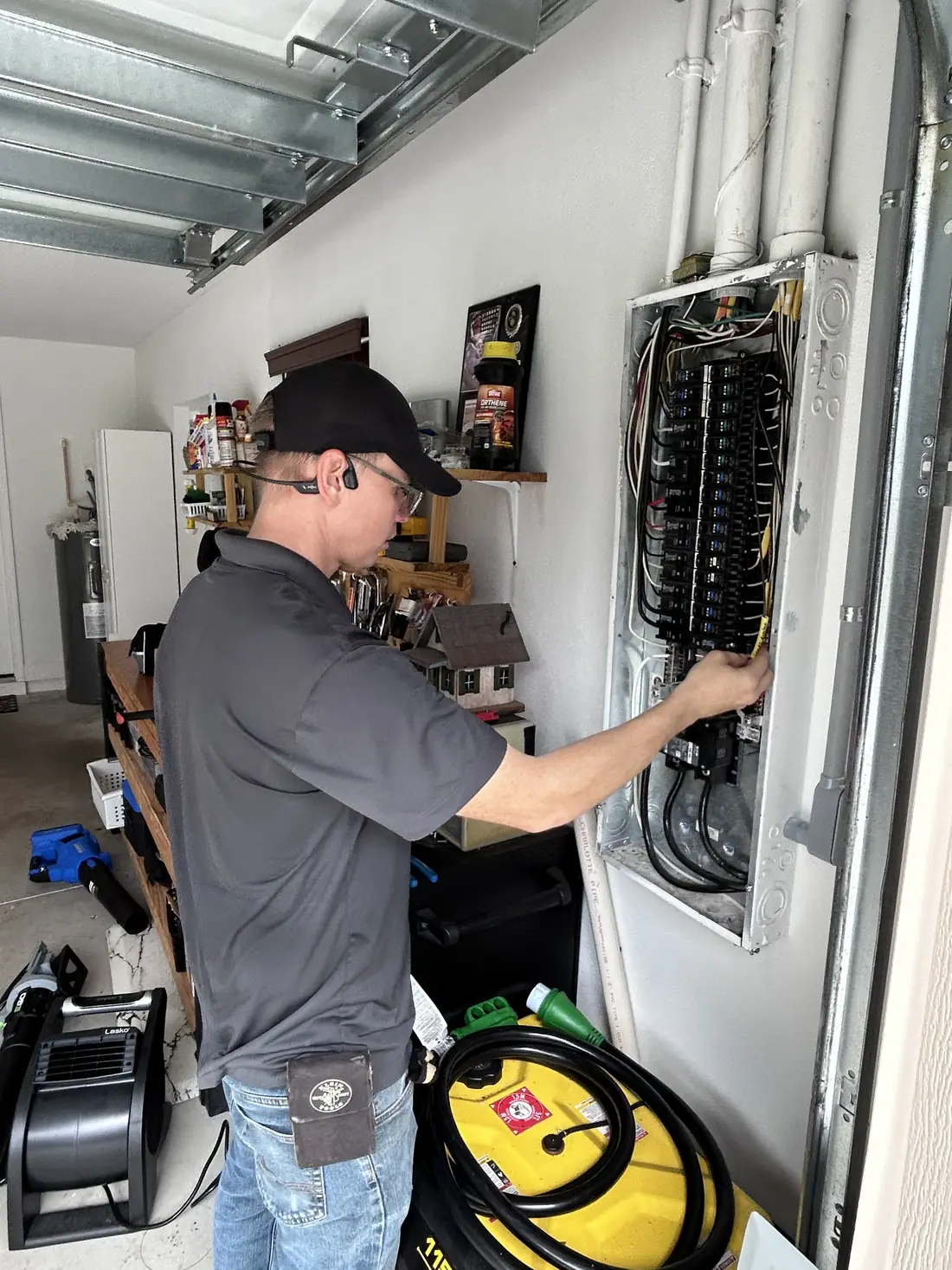
Some electrical problems announce themselves. A breaker is off, an outlet is dead, and the fix is straightforward. The calls that need real troubleshooting are the other kind: the breaker that trips on humid afternoons, the light that flickers only when the dryer runs, the outlet that works until you plug in something that draws current.
Intermittent faults are where guesswork gets expensive. Replacing parts until the symptom goes away can cost more than the diagnosis would have, and it often just relocates the problem. We use circuit tracing, insulation resistance testing, load testing, and thermal imaging to isolate the actual failure point.
Most of our electricians have been working Polk County wiring for more than twenty years. That matters more than any tool, because a lot of troubleshooting is recognising a pattern you have seen in fifty other houses built the same decade by the same builder.
Many customers pair troubleshooting with electrical repair and panel upgrade. Not sure where to start? Read signs you need an electrical panel upgrade in Polk County.
Serving Polk County: Lake Wales, Winter Haven, Bartow, Haines City, Lakeland, Dundee, Frostproof, Auburndale, Polk City, Davenport, Fort Meade, Lake Alfred, and the surrounding Central Florida communities. Call (863) 676-0198 to book.
Problems Worth A Diagnostic Visit
- A breaker that trips intermittently with no obvious pattern
- Lights that flicker or dim on a specific circuit or at a specific time of day
- An outlet or circuit that works sometimes and not others
- A warm spot on a wall, a switch plate, or the panel cover
- A faint burning smell you cannot locate
- A GFCI that trips for no visible reason
- A shock or tingle from an appliance, faucet, or metal fixture
- Higher power bills with no change in usage
“Two neighbors recommended Kincaid to me after a recent lightning strike. Brandon was prompt, courteous, and had to run down my short which was not storm related. This will be my go-to company!”
How We Isolate A Fault
- 1
Interview and reproduce
What happens, when, and what else is running at the time. Half of intermittent diagnosis is finding out what makes the fault appear.
- 2
Map the circuit
We trace what is actually on the affected circuit, which is frequently not what the panel label says.
- 3
Test under load
Voltage drop, insulation resistance, and current draw measured with the circuit doing real work, because faults hide at no load.
- 4
Thermal scan
A loose connection heats up before it fails. Thermal imaging at the panel and at devices finds hot spots that look fine to the eye.
- 5
Repair and verify
We correct the fault, then re-test under the conditions that triggered it originally to confirm it is genuinely gone.
How Intermittent Electrical Problems Get Diagnosed
An intermittent fault is the hardest kind to diagnose, because it does not show up when someone arrives. Diagnosing intermittent electrical problems starts with a conversation. We ask when it happens, what else is running, whether the weather or the time of day makes a difference, and when it started. Those answers tell us what to recreate, and often point toward a loose connection, a moisture path, or a circuit under load.
Once we know what to look for, we test the circuit under real conditions. We check voltage drop while the load is running, measure insulation resistance, and scan connections with a thermal camera, because a loose connection heats up before it fails. Then we repair the fault and test again under the same conditions that triggered it, so we know it is gone and not just quiet.
Lights Flickering In Winter Haven: When To Call An Electrician
Flickering lights in a Winter Haven home can have a harmless cause or a serious one. A dimmer that does not match LED bulbs is a nuisance, and swapping the dimmer or bulb usually solves it. A flicker in one room that changes when you touch the switch or fixture is different, and so is flicker that affects the whole house when the air handler or a large appliance starts.
Those last cases point to loose or corroded connections at a device, the panel, or the meter, and a loose connection can arc and heat up inside a wall. Winter Haven has plenty of older homes and lakefront houses where moisture and aging wiring make that more likely. Call an electrician if the flicker is not tied to a dimmer, if a switch or plate feels warm, or if you smell anything burning.
What Drives The Cost Of Electrical Troubleshooting
The cost of electrical troubleshooting depends mostly on time, because finding the fault is the work. An obvious problem, such as a tripped GFCI or a failed device, goes quickly. A fault that only shows up under certain conditions, or one buried in a circuit nobody has a diagram for, takes longer to isolate. Access matters too, since attics, crawlspaces, and finished walls all add time to the search.
We do not guess at a price before we know what we are dealing with. What we can do is explain the process, tell you what we will check first, and give you the repair price separately once we know the cause, so you can decide on the repair. Paying for the diagnosis does not commit you to the fix. It tells you what is wrong.
Outlet Not Working: A Step By Step Troubleshooting Guide
Start with what you can do safely. Check the panel for a tripped breaker, and press the reset button on any GFCI outlet nearby, including those in the garage, bathrooms, kitchen, and outdoors. Plug a lamp you know works into the outlet, and test the outlets next to it. If a whole group is dead, the problem is upstream of all of them, and you should not keep replacing devices.
Do not open a box you cannot confirm is de-energized, and stop if you see scorched plastic, smell burning, or feel warmth at a plate. That is when to call us. On site, we trace which outlets share the circuit, test for power and a good neutral at each point, and look for a failed connection or a back-stabbed device. Fixing the actual connection is what keeps the outlet working.
An Electrical Diagnostic Service For Homes And Businesses In Polk County
Our electrical diagnostic service covers homes and businesses across Polk County. For a home, that might be a breaker that trips on humid afternoons, a circuit that dies and comes back, or a warm switch plate. For a business, it might be equipment that resets itself, lights that drop out on one run, or a panel that needs a thermal check before a busy season. The method is the same.
We map what is on the circuit, test it under load, scan for hot spots, and repair the cause. In older houses, that often means a loose neutral, a failing splice, or a connection that has worked loose over decades of heating and cooling. In newer buildings it is more often a poorly made termination. Either way, we explain what we found, show you where it was, and verify the repair.
Ready to book troubleshooting?
Licensed, family owned, and working out of Lake Wales since 1973. Upfront pricing, and a real person on the phone.
Other Electrical Repairs Services
Troubleshooting Across Polk County
The same crew covers the whole service area. Pick your city for local detail, or just call us.
Lake Wales/Winter Haven/Bartow/Haines City/Lakeland/Dundee/Frostproof/Auburndale/Polk City/Davenport/Fort Meade/Lake Alfred
Troubleshooting FAQs
Why does my breaker only trip sometimes?
Usually because the fault is load-dependent or moisture-dependent. A marginal connection carries small loads fine and overheats under large ones. A ground fault from moisture appears after rain and disappears when things dry out. Reproducing the condition is the first step in finding it.
Can you find a problem without opening up my walls?
Almost always, yes. Circuit tracing, thermal imaging, and testing at accessible junction points locate the fault to a specific span. We only open drywall when the fault is genuinely inside a wall cavity, and we tell you before we do.
How do you charge for troubleshooting?
Diagnostic work is quoted before we start, and once we know what is wrong we give you the repair price separately so you can decide. You are never committed to the repair just because you paid for the diagnosis.
Is a flickering light actually dangerous?
It can be. A flicker caused by a loose connection means an intermittent arc, and arcing generates heat inside a box you cannot see. A flicker caused by a mismatched LED dimmer is harmless. Telling those apart is the point of the diagnostic visit.
Why do my lights flicker when I turn on appliances?
A brief dip when a large motor starts is normal to a degree, because an air handler or well pump draws several times its running current for the first moment. Flicker that is pronounced, that affects the whole house, or that has got worse over time usually means a loose or corroded connection at the panel, the main lugs, or the meter, or a service undersized for the load. That is measurable: we check voltage drop under the actual starting load rather than guessing.
Can I troubleshoot electrical problems myself?
Some of it, safely. Checking whether a GFCI upstream has tripped, whether a breaker is sitting in the middle position rather than fully off, and whether the problem follows the appliance or stays with the outlet are all worth doing before you call. What we would not have you do is open a panel, work on live circuits, or chase a fault behind a wall. Those are the parts where a mistake stays hidden until it starts a fire.
How long does electrical troubleshooting take?
A straightforward dead circuit or tripped device is often thirty to sixty minutes to find. An intermittent fault that only appears under a particular load or after rain can take considerably longer, sometimes a second visit, because the first job is reproducing the condition that makes it appear. We tell you which category we think yours is before we start, and we keep you informed if it turns out to be the other one.
What should I do if I smell burning near an outlet or switch?
Treat it as urgent. Switch that circuit off at the breaker, unplug what you can reach safely, stop using the outlet or switch, and call us. A burning or hot plastic smell means something is arcing or running far hotter than it should, and the smell usually arrives well before any visible damage does. We keep availability for exactly this kind of call.
Are electrical repairs covered by home insurance?
Sudden accidental damage, such as a lightning event that takes out a circuit or an appliance, is often covered. Wear, corrosion, and outdated wiring generally are not, because carriers treat those as maintenance. If unpermitted work by an unlicensed party contributed to the failure, that gives a carrier grounds to decline. We document what we found and what we did, which is what an adjuster will ask for.