
Published
People search recessed lighting when a living room or kitchen still has one fixture in the middle of the ceiling. In a finished Polk County house the job is not a catalog of cans. It is whether the attic can be walked, whether the insulation will touch the housing, and whether the existing switch can feed the new lights.
Kincaid Electric installs lighting in houses that are already lived in. The price is written down after we see the ceiling, the attic, and the panel.
What the search is asking
Google’s answers for recessed lighting describe new-construction housings, remodel housings, and thin LED wafers. Those three products exist. The useful question in Lake Wales, Winter Haven, Bartow, or Lakeland is which one fits the ceiling you already have.
A new-construction housing nails to the joists before drywall. That is a builder’s sequence. A remodel housing clips into a hole cut in finished drywall. A wafer is a thin LED with a small junction box in the attic, and it is what we use when the space above the ceiling is tight.
Attic access decides the job
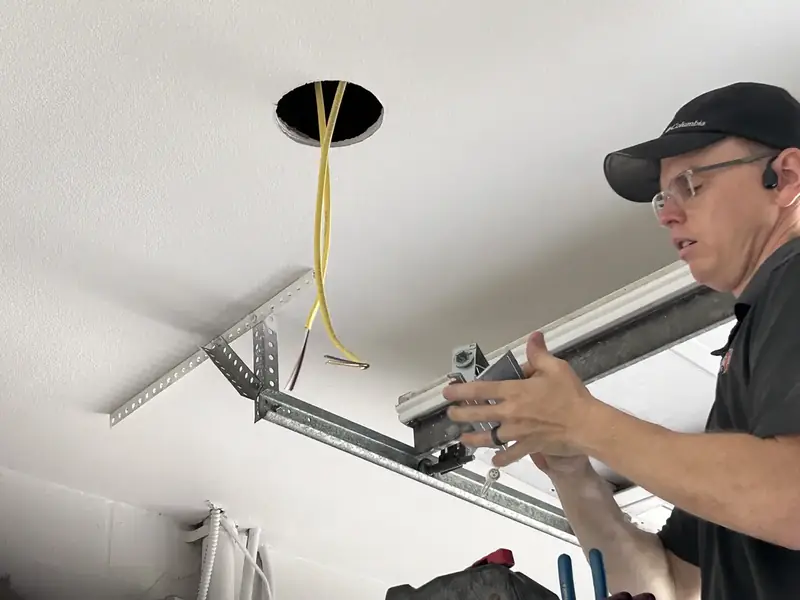
If we can get above the ceiling, we can see the joists, the insulation, and the old cable. That is the cleaner way to add lights in a one-story house. Two-story rooms and tray ceilings often have no attic over them. Those rooms use a remodel housing or a wafer that can be wired from the hole.
We do not cut a row of holes and then discover a duct, a truss, or a cable we cannot move. The layout is marked on the ceiling after the attic is looked at, or after a small inspection hole if there is no attic.
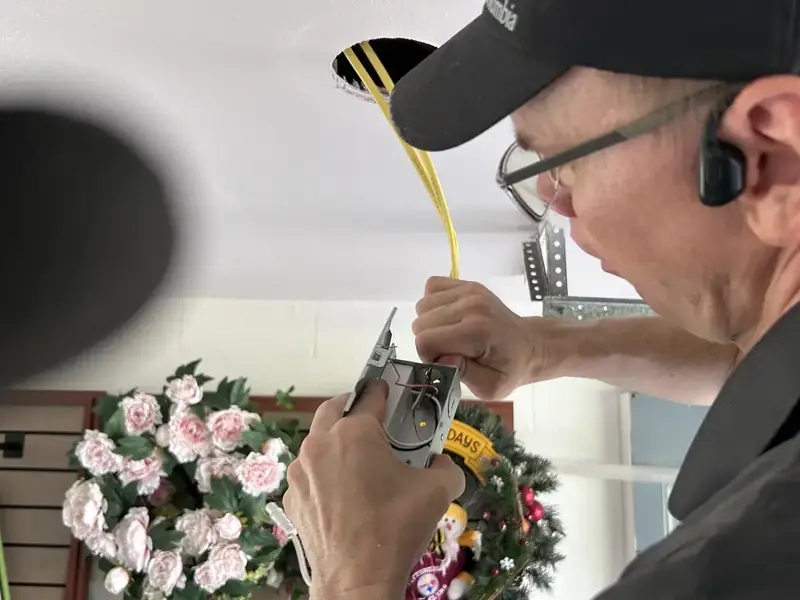
Insulation contact
A housing that is not rated for insulation contact needs clear space around it. Blown insulation in a Polk County attic will cover that housing the first time the attic is touched. We use housings and wafers that are rated to sit in insulation.
A bathroom over a shower, a covered porch, and a soffit need a wet-location listing. A living room does not. Mixing those ratings is how a fixture fails the first wet season.
How many lights, and how far apart
A 6-inch light is the usual general light. A 4-inch light is for a counter, a hallway, or a smaller room. Spacing near four to six feet is a start. The real layout follows the cabinets, the island, and the places you stand. A straight row down the middle of a living room lights the floor and leaves the seating dark.
Color temperature is a switch on the back of many LED wafers: warmer for a bedroom, cooler for a kitchen. We set it before the trim goes on. Changing it later means taking the light down.
The switch and the dimmer
An old dimmer made for an incandescent bulb will buzz or flicker with LEDs. The dimmer has to be listed for LED loads, and the total wattage of the lights has to sit inside the dimmer’s range. A room that already has a switch can often stay on that switch. A room that needs two levels of light needs a second switch leg.
Smart switches need a neutral in the box. A lot of older switch loops in this county have a hot and a switched hot and nothing else. We check the box before anyone buys a stack of switches.
When a new circuit is required
Swapping one fixture for one fixture is often the same circuit. A kitchen that goes from one light to twelve is a new load, and it often needs its own circuit, a permit, and an inspection. We say that at the estimate. We pull the permit when the work requires one.
The panel has to have a space and the ampacity. If the panel is already full, the lighting job and a panel upgrade are two prices, not one surprise.
What to tell us before the visit
Room sizes, whether there is an attic hatch, and photos of the existing fixture and the switch are enough to start. If you already bought lights, send the model so we can check the listing and the rough-in size.
Shop hours are Monday through Friday, 7:30 AM to 4:30 PM. The number is (863) 676-0198, or use the contact page. Florida master license EC0000873. The shop is at 15510 Hwy 27, Lake Wales, FL 33859.
More from us: all electrical services and the cities we serve.